
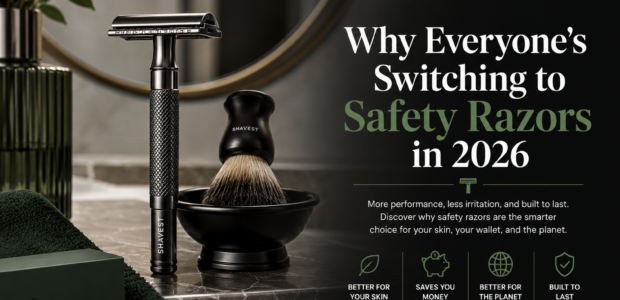

Two billion. That’s roughly how many disposable razors end up in landfill every year. If you’ve ever briefly thought about that figure while throwing one away and then immediately moved on with your morning, you’re not alone. For most people, convenience wins. But that calculation has been shifting, quietly at first, then fast. The safety razor trend 2026 is no longer a niche choice made by sustainability enthusiasts and wet shaving purists. It has become a mainstream one, and the numbers behind it are fairly clear about why.
The Numbers First
The global safety razor market was valued at approximately $5.89 billion in 2025, with consistent year-on-year growth driven by two forces that don’t usually arrive together: environmental concern and plain economics. More than 61% of users now favour durable, reusable razors over disposable alternatives.
Among millennials specifically, the adoption rate is 42%, nearly half a generation that grew up on cartridge razors has made the switch. Over 58% of American consumers have expressed a preference for razors with recyclable or metal components. These are not fringe numbers. Something has genuinely changed.
Why Switch to a Safety Razor: Three Reasons That Actually Hold Up
Ask someone why switch to safety razor and you’ll usually get one of three answers, depending on who they are and what moved them.
- The environmental case is the most discussed. Disposable plastic razors contribute over 45% of total shaving-related plastic waste, and unlike most plastic, they are rarely recyclable due to their mixed-material construction, metal blade bonded to plastic casing.
A safety razor, by contrast, is designed to last years or decades. Only the blade is replaced, and replacement blades typically come in recyclable paper packaging. The environmental delta between a safety razor used for five years and five years worth of disposable cartridges is not marginal. It is enormous.
- The cost case is slower to materialise but more durable once it does. The razor itself costs more upfront. A quality metal handle runs anywhere from $30 to $80. But replacement double-edge blades cost a fraction of what cartridge refills do, often less than $0.30 per blade versus $3 to $5 per cartridge. Within six months to a year, most people who make the switch have broken even. After that, the savings compound.
- The skin case is the one that tends to surprise people most. Multi-blade cartridge razors are engineered to pull the hair before cutting it, which produces a very close shave but also drags the blade across the skin four or five times in a single stroke. For anyone with sensitive skin or a tendency toward ingrown hairs, that repeated trauma is exactly the problem.
A single-blade safety razor cuts cleanly at the surface, one pass, and research suggests it reduces skin irritation by up to 27% compared to multi-blade cartridges. The learning curve is real, but it takes most people about two weeks to adjust.
The Eco Friendly Razor Question
Not all eco friendly razor options are safety razors, and not all safety razors are equally sustainable, worth knowing before you shop. The material that matters most is the handle. Stainless steel and brass are the most durable and fully recyclable. Bamboo handles are increasingly common and make for a genuinely sustainable choice if you don’t mind slightly less heft.
Avoid anything described as ‘eco-friendly’ that still uses a plastic cartridge system with metal blades bonded in, the cartridge is where most of the waste lives, and swapping the handle material without addressing it is mostly cosmetic.
A Note on Sustainable Shaving Technique
The other half of sustainable shaving that rarely gets mentioned: the products around the razor. Shaving foam in a pressurised can is, by weight, mostly propellant and water in a non-recyclable aerosol container. Switching to a shaving soap or solid bar not only reduces packaging waste dramatically but also tends to produce a better lather that helps the razor glide, which matters more with a single blade than with a cartridge.
The full sustainable shaving routine, metal razor, soap bar, recyclable blade disposal tin, takes maybe two extra minutes to set up and then runs on its own indefinitely.
If you’re considering making the switch, Shavest’s razor range is worth looking at for a design-forward entry into the category. Current promo codes are listed on health and beauty. Most people who switch describe the same experience: a slightly uncomfortable first week, followed by a shave quality they didn’t know they were missing.