
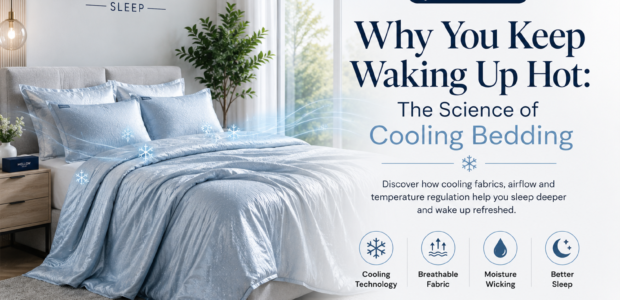

You went to bed at a reasonable hour. The room was dark. Nothing was particularly wrong. And yet somewhere around 2am you surfaced, kicking off the covers, vaguely damp, waiting for the ambient air to cool you back down. If that sequence is familiar, the reason is almost certainly not the room temperature or the time of year. It is, in most cases, your bedding, specifically, what it is made of and how your body interacts with it during sleep.
What Your Body Is Actually Doing While You Sleep
Sleep onset is not just a mental process. It is also a physical one, tied directly to your core temperature. For your body to move from wakefulness into the deeper stages of sleep, your core temperature needs to drop by roughly 1 to 2 degrees Fahrenheit. This is why a hot shower before bed can paradoxically help you fall asleep faster, it pulls blood to the surface of your skin, accelerating heat loss from your core. The bedroom becomes a tool in that process, and so does everything you are lying on and covered with.
Research published in the journal Frontiers in Neuroscience confirmed that the optimal ambient temperature for sleep sits between approximately 66 and 70 degrees Fahrenheit (19 to 21 degrees Celsius). Within that range, the body tries to maintain a skin microclimate of roughly 88 to 95 degrees Fahrenheit, a narrow band. Stray outside it for long enough, in either direction, and sleep quality degrades. The complication is that why do I sleep hot rarely has a single answer. Ambient temperature matters, but so does what you are sleeping under.
REM sleep is where the problem compounds. During this stage, the body largely suspends its own temperature-regulation mechanisms, sweating, shivering, and other thermal responses quiet down considerably. That makes REM the sleep stage most sensitive to external heat. When bedding traps warmth around your body and the surrounding air cannot carry it away, the body has fewer tools available to correct for it. The result is often a fragmented night, or a slow bleed of wakefulness that you only notice after the fact.
Why Material Matters More Than Thread Count
Thread count became a dominant bedding marketing metric for reasons that have more to do with perceived luxury than actual performance. For hot sleepers, it is largely the wrong thing to optimize for. Above 400 thread count, sheets generally become denser and less breathable, exactly the opposite of what someone waking up overheated needs. The more useful variables are fiber type and weave construction.
On fiber: temperature regulating sheets tend to come from one of three sources. Percale cotton, woven with a one-over-one-under structure that leaves the fabric open and airy, has the crispness and airflow that many hot sleepers describe as genuinely cooling at the start of the night.
Bamboo lyocell excels at moisture-wicking and temperature regulation while feeling noticeably softer than cotton at equivalent price points, making it a strong option for anyone who runs hot and also sleeps sweaty. Linen, counterintuitively, is the most breathable natural bedding material available, it has a rougher initial texture that softens considerably with washing, and it regulates temperature better than almost anything else in warm climates or for extreme heat sensitivity.
What to avoid is fairly consistent across sleep experts: dense sateen weaves, synthetic microfiber blends marketed as ‘cool-touch,’ and anything with a polyester content above about 20 percent. Polyester retains heat. Dense sateen weaves restrict airflow. These two things combine badly for someone who already sleeps warm.
The Comforter Is Usually the Culprit
Sheets get the most attention in cooling bedding coverage, but the breathable comforter is often where the real problem lives. A thick synthetic comforter acts like insulation designed to keep heat in, which is exactly what you want in January and precisely what you do not want on a night when the room sits at 70 degrees and your body is trying to shed heat through your skin. The solution is not always to remove the comforter entirely, for most people, some weight or coverage aids sleep, but to replace a heat-retaining one with something lighter and more breathable.
Down and down-alternative comforters in lower fill powers (around 400 to 550) typically allow more airflow than high-fill-power winter duvets. Bamboo and Tencel-shell options take this further, using moisture-wicking outer materials that actively pull heat away from the surface. The test for a cooling bedding setup is simple: if you wake up warm but not sweating, the sheets are probably the issue. If you wake up damp, the comforter is almost certainly contributing.
What to Actually Change First
Start with the comforter or duvet before touching the sheets. It has the highest surface area in contact with your body and the most thermal mass to retain or release heat. If you already sleep under something lightweight and still wake up hot, then move to the sheets — swapping a sateen for a percale, or a cotton blend for a bamboo lyocell, will make a more immediate difference than most people expect from what seems like a minor fabric change.
If you are in the market for an upgrade on either front, Mellow Sleep’s bedding range is worth looking at for options built around breathability rather than just warmth. Verified discount codes for Mellow Sleep and other home and bedding brands are on ShopMeNot, updated daily as new deals go live.