
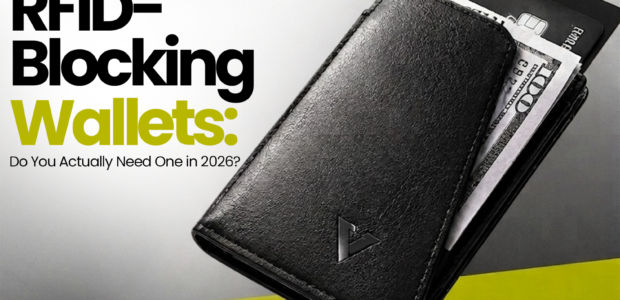

Somewhere in the last decade, a very specific kind of fear took hold: a stranger walks past you on the subway, holds a hidden scanner near your pocket, and walks away with your card number before you’ve even noticed they were there. It’s a good story. It’s also, according to nearly every fraud researcher, bank, and security expert who’s actually studied it, mostly fiction. So before you spend money on a RFID blocking wallet, it’s worth asking the less exciting but more useful question: does any of this actually happen to real people?
Quick Refresher: What RFID Actually Is
Your contactless credit card has a tiny chip and antenna inside it. Hold it near a payment terminal and it talks to that terminal using radio waves, that’s the tap-to-pay you’ve gotten used to. The same basic tech (RFID, or more specifically a flavor of it called NFC) is what lets you scan a card without swiping it. An RFID-blocking wallet works by lining itself with a conductive material, usually a thin layer of metal, that interrupts those radio waves while your card is tucked inside. In theory, it stops anyone with a scanner from reading your card without you knowing.
So Do I Need RFID Protection? Here’s What the Evidence Actually Says
This is where things get more interesting than the marketing usually lets on. Security researchers have demonstrated, under lab conditions, that RFID skimming is technically possible. But ‘possible in a lab’ and ‘happening to people on the street’ turn out to be very different claims. Visa’s own fraud guidance describes skimming losses as ‘very unlikely and limited in scope,’ and Chase’s head of consumer banking practices has put it even more plainly: he personally doesn’t worry about it. Fraud researchers tracking actual reported cases describe RFID theft the same way, again and again, as theoretical rather than something showing up in real victim reports.
Part of the reason is technical. Modern cards don’t just transmit your raw card number when scanned, they generate a one-time encrypted code for that specific transaction, tied to a specific terminal, that expires almost immediately and is missing the CVV needed for most fraud anyway. Even in the rare case someone did manage to skim a read, what they’d walk away with is close to useless. Compare that to the old magnetic-stripe skimmers from twenty years ago, which really could clone a working card, and you start to see why this particular fear hasn’t aged well.
If Skimming Isn’t the Real Threat, What Is?
Nearly every expert who downplays contactless card skimming points to the same alternative: you are dramatically more likely to lose money through a data breach, phishing email, or your card details showing up for sale after some retailer got hacked, than from a stranger scanning your pocket on the train.
One fraud strategist put it bluntly, people being careless with their actual card numbers, leaving them written down or visible, is a bigger everyday risk than any invisible scanner. If you’re serious about protecting yourself, strong unique passwords, transaction alerts on your accounts, and a healthy suspicion of unexpected texts or emails asking you to “verify” your card will do more than any wallet feature.
The Honest Verdict
None of this means RFID blocking is pointless, it’s just not the headline reason to buy a wallet. If it comes built into a smart wallet 2026 you were already considering for other reasons, better card organization, slimmer design, a tracking card, MagSafe compatibility, there’s genuinely no downside to having it. It costs you nothing in daily use, doesn’t slow down a legitimate tap-to-pay transaction once your card is out, and covers the one scenario, however rare, where it would matter. Where it stops making sense is spending extra purely for the RFID label, or assuming a wallet without it is somehow leaving you exposed. It mostly isn’t.
That’s roughly the philosophy behind wallets like Ekster’s smart wallet lineup, RFID shielding is included as a baseline feature rather than the entire pitch, alongside things people actually weigh a purchase on day to day, like card capacity and build quality. If you’re shopping for one, you can check the current promo codes for Ekster and other wallet and accessory brands on ShopMeNot.